Book projects
| Book projects | ||||
Key issues in M-Learning Research and Practice (due 2014) Editors: Norbert Pachler, John Cook and John Traxler |
||||
Work-based mobile learning: concepts and cases. A handbook for evidence based practice (2009-2010) Editors: Norbert Pachler, Christoph Pimmer and Judith Seipold |
||||
| Mobile Learning: Structures, Agency, Practices (2007-2009) Authors: Norbert Pachler, Ben Bachmair and John Cook, with
contributions from Gunther Kress, Judith Seipold, Elisabetta Adami and
Klaus Rummler |
||||

Research & development projects
| Research & development projects | ||||
| Network for Mobile Learning Scenarios (2012-ongoing) In collaboration with institutions in United Kingdom, Germany, Austria, Switzerland and Italy. Aim of the network is to provide perspectives for the implementation of mobile technologies in teaching and learning contexts, be it formal or informal, during school or leisure time, at workplace or university, or in which place or time of the day ever, by providing “scenarios” for learning and teaching with mobile technologies. In contrast to large-scale projects scenarios can be understood as modular units which are replicable, scalable and transferable and apply to the use in specific learning. Part of the conceptual considerations of the network is a perspective of a cultural ecology which covers amongst others the everyday use of mobile technologies, different social contexts and milieus in which people are learning, as well as different demands of educational institutions and their policies. Target groups of the work of the network are teacher and researchers. |
||||
| Learning Layers (2012-ongoing) In collaboration with institutions in Austria, Estonia, Finland, Germany, Norway, Spain, and the UK. In the Learning Layers Project (http://learning-layers.eu) we develop technologies that support informal learning in the workplace (Healthcare professionals in NE England and the Construction sector in North Germany). John leads on work that aims to understand how and why people choose to connect to other people for intentional informal learning and to discover approaches to improve trust and interactions between people, thereby enhancing the construction of learning networks. |
||||
| SoMobNet - Social Mobile Network to enhance community building for adults’ informal learning (2011-2012) In collaboration with the University of Florence, the Consiglio
Nazionale delle Ricerche and Attiko Vocational Training Centre. The aim of the partnership is to explore the role mobile and social networking can play in the context of technology-enhanced learning environments with a focus on workers’ community building. It investigates the following research questions: how can/do mobile devices support workers’ community building through social networks? What models of assessment are possible through new mobile devices in informal learning situations? How can mobile devices support workers’ training between real and online contexts? Project website. |
||||
| mLeMan (2010-2012) LTRI is a partner in a new EC-funded project called mLeMan (m-Learning Manager). This new Leonardo da Vinci project is led by Plovdiv University in Bulgaria and has a total budget of 475,351 euro. The total budget for LTRI is 84,731 euro or £70,657. John Cook leads for LTRI; Carl Smith will also work on the project. Other mLeMan partners are from Ireland, Italy, Austria and Bulgaria. mLeMan starts October 2010 and runs for 24 Months. |
||||
| MyMobile - Education on the move. Responsive learning contexts in European Adult Education (2010-2012) In collaboration with partners from Germany (medien+bildung.com),
Italy (Facoltà di Scienze della Formazione, Università degli
Studi di Firenze) and Belgium (Media Animation asbl). |
||||
| MyMobile (2009-2010) In collaboration with medien+bildung.com |
||||
"And don't forget to bring your mobile" - Informing educational target groups about mobile learning opportunities (2008-2010) Supporter: WLE Centre, IoE, London. |
||||
| Researching the interface between emerging technologies, in particular interactive displays, and representation on learning (2008-2009) Joint project with the Centre for Multimodal Research at the Institute of Education, London. |
||||
Mobile Medienbildung - Mobile Education: Educational potentials of mobile technology for adolescent 'at-risk learners' (2007-2011) PhD thesis: Klaus Rummler, University of Kassel, Germany |
||||
Mobiles Lernen. Analyse des Wissenschaftsprozesses der britischen und deutschsprachigen medienpädagogischen und erziehungswissenschaftlichen Mobile Learning-Diskussion. [Mobile Learning. Analysis of the scientific process of the British and German speaking media educational and educational mobile learning discussion.] (2007-2011) PhD thesis: Judith Seipold, University of Kassel, Germany |
||||
A Design Toolkit for Emerging Learning Landscapes Supported by Ubiquitous Computing Ph.D. Thesis, Daniel Spikol, Linnaeus University, V�xj�,
Sweden |
||||
MoLeaP - The mobile learning project database
| MoLeaP - The mobile learning project database | ||||
|
|
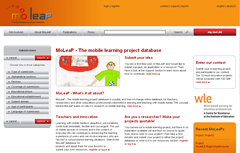
MoLeaP - The mobile learning project database is a public and free-of-charge online database for teachers, researchers and other (education) professionals interested in learning and teaching with mobile media. The concept behind MoLeaP builds on LMLG's research on mobile learning. MoLeaP is part of the project "And don't forget to bring your mobile" - Informing educational target groups about mobile learning opportunities. |
|||
Literature database
| Literature database | ||||
|
|
The literature database of the London Mobile Learning Group (LMLG) contains a vast range of references with a wider relevance to mobile learning. Besides the almost 400 references that were cited in the book 'Mobile Learning: Structures, Agency, Practices' (Springer, 2010) this resource contains approximately 1400 additional references. |
|||